
Market & Legal Update
October 2026
Market Update | Higher for Longer Is Starting to Feel Permanent
October delivered a notable shift in market leadership as investors reassessed the outlook for artificial intelligence spending, inflation and interest rates. U.S. large-cap equities produced mixed results throughout the month, with the technology-heavy NASDAQ falling 5.3% as several of the market's largest growth companies came under pressure from rising capital expenditure concerns. The S&P 500 finished the month down 0.9%, while the Dow Jones Industrial Average gained 1.8% as investors rotated toward more traditional sectors of the market. International equities also faced headwinds, with MSCI EAFE and MSCI Emerging Markets declining 0.7% and 8.1%, respectively. Fixed income markets provided a rare bright spot, as easing Treasury yields helped the Bloomberg U.S. Aggregate Bond Index gain 2.4% during the month. More importantly, October continued to reinforce the market's central theme for 2026: expectations for lower interest rates have gradually given way to the realization that rates may remain higher for considerably longer than investors anticipated at the beginning of the year.
| Market Return Indexes | Oct 2026 |
YTD 2026 |
2025 |
|---|---|---|---|
| Dow Jones Industrial Average | 1.8% | 9.1% | 14.9% |
| S&P 500 | -0.9% | 11.8% | 17.9% |
| NASDAQ (price change) | -5.3% | 9.4% | 20.4% |
| MSCI Eur. Australasia Far East (EAFE) | -0.7% | 9.5% | 31.2% |
| MSCI Emerging Markets | -8.1% | 13.5% | 33.6% |
| Bloomberg High Yield | 0.3% | 0.4% | 8.6% |
| Bloomberg U.S. Aggregate Bond | 2.4% | -0.5% | 7.3% |
| Yield Data (Month End) | Oct 2026 |
Sept 2026 |
Aug 2026 |
| U.S. 10-Year Treasury Yield | 4.94% | 5.29% | 4.71% |
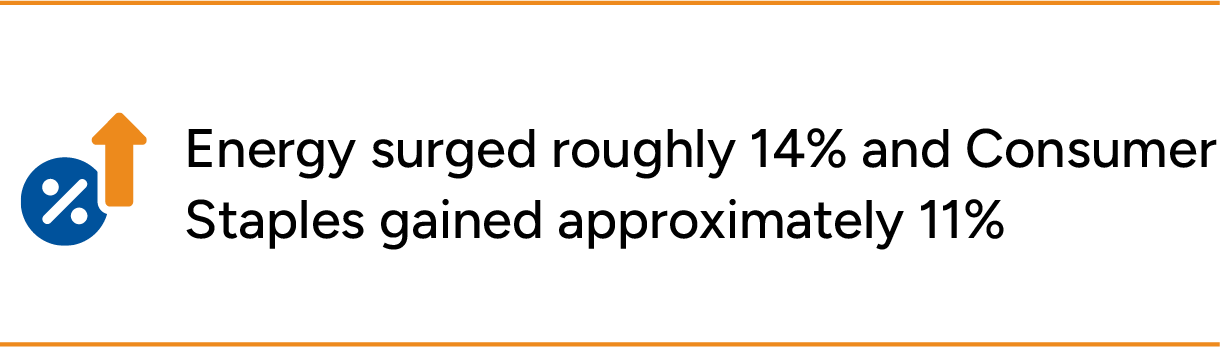
While headline index returns told part of the story, the picture beneath the surface was far more telling. October produced a dramatic shift in market leadership, with performance rotating away from many of the mega-cap technology and artificial intelligence beneficiaries that had driven returns for much of the year and toward more traditional, value-oriented sectors. Concerns surrounding elevated AI-related capital expenditures weighed on several large technology companies, while the PHLX Semiconductor Sector Index declined approximately 15% during the month. Meanwhile, Energy surged roughly 14% and Consumer Staples gained approximately 11% as investors favored earnings stability, cash flow generation and sectors perceived to be better positioned in a higher-rate environment. On the consumer side, the Conference Board's Consumer Confidence Index beat expectations, climbing 7.5 points to 91.7, aided in part by a decline in average gasoline prices from $4.48 to $4.27 per gallon during the month.
To fully understand October, it helps to understand the year it has been. Entering 2026, investors broadly expected inflation to continue moderating and the Federal Reserve to begin lowering interest rates, with markets anticipating at least one rate cut during the year. Instead, stronger-than-expected economic growth, robust AI infrastructure investment and oil-price shocks stemming from Middle East tensions kept inflation more persistent than anticipated. What initially appeared to be a temporary period of elevated rates has increasingly evolved into a higher-for-longer environment, reinforced by growing competition for capital from AI infrastructure buildouts, defense spending and deficit financing all competing simultaneously for investor dollars.
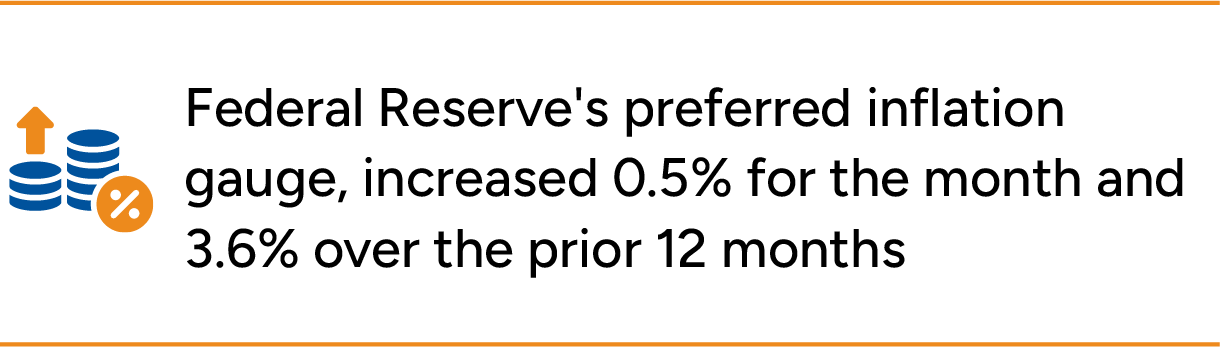
Recent inflation data continued to support that outlook. September's Consumer Price Index showed headline inflation rising to 3.7% year-over-year, up from 3.4% in August, largely driven by higher energy prices. Released on October 29, September's Personal Consumption Expenditures (PCE) index, the Federal Reserve's preferred inflation gauge, increased 0.5% for the month and 3.6% over the prior 12 months, accelerating from August's 3.4% annual reading. Core PCE, which excludes food and energy and is most closely monitored by policymakers, rose 0.3% for the month and 3.1% year-over-year. Against that backdrop, the Federal Reserve left its benchmark rate unchanged at 3.75% to 4.00% at its October meeting, though Chairman Warsh signaled that additional tightening remains firmly on the table, with markets now pricing in a roughly 69% probability of a 25-basis-point hike at the December 9 meeting.
The broader economy, meanwhile, continues to display surprising resilience. The advance estimate of third-quarter GDP showed the U.S. economy expanding at an annualized rate of 3.4%, its strongest quarterly pace in more than a year, fueled by healthy consumer spending growing at a 3.8% annualized rate and continued investment in AI infrastructure. A measure of underlying private-sector demand rose at a 4.9% annualized pace, its strongest reading since 2021. The labor market continued to cool without showing signs of meaningful deterioration, with nonfarm payrolls adding just 29,000 jobs in September and downward revisions trimming a combined 60,000 jobs from prior months, while the unemployment rate held steady at 4.2%. The result is an economy that is moderating rather than unraveling, which provides little urgency for the Federal Reserve to change course.
As October comes to a close, perhaps the most interesting signal the market sent was not in the economic data but in where investors chose to put their money. The sharp rotation away from the mega-cap growth names that have led markets for much of the past two years and toward energy, staples and value-oriented sectors may reflect a broader recalibration as investors weigh elevated borrowing costs against lofty AI-driven valuations. Whether this rotation marks the beginning of a broader leadership shift or simply a one-month pause remains to be seen, but one thing is increasingly clear heading into year-end: the higher-for-longer interest rate environment is no longer merely a forecast, and markets are beginning to price it that way.
Legal Update | Treasury and IRS Release 2026–2027 Priority Guidance Plan: What It Means for Retirement Plan Sponsors

A New Rhythm for Guidance Planning
On September 29, 2026, the Treasury Department and IRS released the inaugural 2026–2027 Priority Guidance Plan, marking a significant procedural change. Beginning with this cycle, the Priority Guidance Plan will align with the federal government's fiscal year. As a result, the plan identifies projects that will receive priority for Treasury and IRS resources during the period from October 1, 2026, through September 30, 2027.
This year's plan is expansive, containing 121 guidance projects that reflect the agencies' focus on continued implementation of the One Big Beautiful Bill Act, deregulation and burden reduction initiatives, tax-exempt organizations, tribal tax issues, digital assets and other key policy priorities.
For retirement plan sponsors, however, the most notable developments involve the continued implementation of SECURE 2.0, several technical defined benefit plan projects and the IRS's recent release of long-awaited Employee Plans Compliance Resolution System (EPCRS) guidance.
SECURE 2.0: Continued Implementation
The Priority Guidance Plan confirms that regulators continue to work through several core SECURE 2.0 provisions affecting plan design and administration.
Among the projects identified are guidance addressing:
- Section 103 (Saver's Match)
- Section 110 (Qualified Student Loan Matching Contributions)
- Section 125 (Long-Term, Part-Time Employees)
- Section 127 (Pension-Linked Emergency Savings Accounts)
- Section 324 (Rollover Rules)
- Certain distribution provisions under Code Section 72(t)
In addition, the IRS has identified several related projects that plan sponsors should continue to monitor, including:
- Modifications to required minimum distribution rules under Code Section 401(a)(9)
- An exception to the unified plan rule for Section 413(e) multiple employer plans
- Automatic enrollment requirements under Code Section 414A
- Updates to EPCRS
- A new IRA Compliance Resolution System
- Catch-up contribution guidance
- Guidance addressing uncashed retirement plan checks
Update: EPCRS Guidance Already Issued
One of the highest-profile items on the Priority Guidance Plan has already been addressed. On October 22, 2026, the IRS issued Revenue Procedure 2026-34, a comprehensive update to the Employee Plans Compliance Resolution System (EPCRS), the IRS's correction program for retirement plan failures.
The new revenue procedure supersedes Revenue Procedure 2021-30 and incorporates various pieces of interim guidance issued since that time. While the familiar three-part EPCRS framework remains intact, consisting of the Self-Correction Program (SCP), Voluntary Correction Program (VCP) and Audit Closing Agreement Program (Audit CAP), the updated guidance expands and refines available correction methods. Revenue Procedure 2026-34 became effective immediately upon issuance.
The IRS also established a new correction program for certain IRA-related failures that are not eligible for correction under EPCRS. This new IRA Compliance Resolution System will become available on May 1, 2027. Until then, IRA custodians and owners will need to rely on existing correction mechanisms where available.
Given the significance of these changes, plan sponsors and administrators should review the new guidance carefully and evaluate whether any pending or anticipated compliance issues may be affected.
Other Technical Priorities for Defined Benefit Plans
The guidance plan also continues several projects of particular importance to defined benefit and cash balance plan sponsors. Industry groups, including the American Academy of Actuaries' Pension Committee, have encouraged the IRS to prioritize guidance addressing:
- EPCRS issues arising under SECURE 2.0
- Cash balance plans
- Funding method changes
- Funding balances
- Code Section 420 transfers
- Closed-plan nondiscrimination testing
- Affiliated service group issues under Code Section 414(m)
Cash balance plans remain an area of particular interest, especially market-based cash balance plans. SECURE 2.0 included changes to the anti-backloading rules intended to facilitate these plan designs, and additional guidance remains highly anticipated.
A Reminder on Amendment Deadlines
Separately, the IRS and Treasury recently clarified amendment deadlines related to the SECURE and SECURE 2.0 Act implementation. Most employer-sponsored retirement plans generally have until December 31, 2026, to adopt discretionary amendments implementing the SECURE and SECURE 2.0 Act provisions, although later deadlines apply to certain collectively bargained plans.
Importantly, amendments required to implement future guidance generally must be adopted by the end of the second plan year following the year in which the guidance appears on the Required Amendments List. Consequently, guidance finalized during 2027 could result in amendment deadlines extending into the 2029 plan year.
|
What This Means for Plan SponsorsAlthough the Priority Guidance Plan provides a roadmap rather than a binding timeline, the recent release of Revenue Procedure 2026-34 demonstrates that the IRS is actively moving forward on several important retirement plan initiatives. Plan sponsors should consider taking the following steps:
We will continue to monitor developments under the 2026–2027 Priority Guidance Plan and provide updates as proposed guidance and final regulations are issued. Please contact us with any questions regarding these developments and their potential impact on your retirement plan. |
Retirement Resources for You
USI's team of experts is happy to assist employers with all retirement plan compliance matters and changes in the market, including those discussed here, to help you mitigate risk and financial impact to your organization.
Questions? Contact your USI retirement representative, visit our Contact Us page or reach out to us directly at information@usicg.com.
Find the address and telephone number of your local USI office here.

Print this October 2026 Market & Legal Update
For previous market and legal commentaries please click here.
This communication is published for general informational purposes and is not intended as advice or a recommendation specific to your plan. Neither USI nor its affiliates and/or employees/agents offer legal or tax advice.
An index is a measure of value changes in a representative grouping of stocks, bonds, or other securities. Indexes are used primarily for comparative performance measurement and as a gauge of movements in financial markets. You cannot invest directly in an index and, for comparative purposes; they do not reflect the effect of the various fees inherent in actual investment vehicles.
The S&P 500 Index is a market value weighted index showing the change in the aggregate market value of 500 U.S. stocks. It is a commonly used measure of stock market total return performance.
The Dow Jones Industrial Average is a price weighted index comprised of 30 actively traded blue chip stocks; primarily industrial companies, but including some service oriented firms.
The NASDAQ Composite Index is a market-value weighted index that measures all domestic and non-U.S. based securities listed on the NASDAQ Stock Market.
Gross Domestic Product (GDP) is the market value of the goods and services produced by labor and property in the U.S. It is comprised of consumer and government purchases, net exports of goods and services, and private domestic investments. The Commerce Department releases figures for GDP on a quarterly basis. Inflation adjusted GDP (or real GDP) is used to measure growth of the U.S. economy.
The MSCI Europe and Australasia, Far East Equity Index (EAFE) is a market capitalization weighted unmanaged index developed by Morgan Stanley Capital International to measure approximately 1,100 securities in 21 major overseas stock markets. It is a commonly used measure for foreign stock market performance.
The Barclays Capital U.S. Aggregate Index covers the U.S. Dollar denominated investment grade, fixed-rate, taxable bond market of SEC-registered securities.
The Barclays Capital U.S. Corporate High Yield Index covers the U.S. Dollar denominated, non-investment grade, fixed income, taxable corporate bond market. Securities are classified as high-yield if the middle rating of Moody’s Fitch, and S&P is Ba1/BB+/BB+ or below.
The MSCI Emerging Markets Index (EM) is a free-float-adjusted market-capitalization index developed by Morgan Stanley Capital International. It is designed to measure the equity market performance of 26 emerging market countries.
The 10 Year Treasury Yield is the interest rate the U.S. government pays to borrow money for a 10-year period. In addition to influencing how much the government pays to borrow over this time-frame, the 10-year Treasury Yields also determines how much investors earn by investing in this debt and it is a good indicator of investor sentiment The higher the yield, the better the economic outlook.
Market Update is a monthly publication circulated by USI Advisors, Inc. and is designed to highlight various market and economic information. It is not intended to interpret laws or regulations.
This report has been prepared solely for informational purposes, based upon information generally available to the public from sources believed to be reliable, but no representation or warranty is given with respect to its completeness. This report is not designed to be a comprehensive analysis of any topic discussed herein, and should not be relied upon as the only source of information. Additionally, this report is not intended to represent advice or a recommendation of any kind, as it does not consider the specific investment objectives, financial situation and/or particular needs of any individual client.
Investment Advice provided by USI Advisors, Inc. Under certain arrangements, securities offered to the Plan through USI Securities, Inc. Member FINRA/SIPC. 95 Glastonbury Blvd., Suite 102, Glastonbury, CT 06033. USI Consulting Group is an affiliate of both USI Advisors, Inc. and USI Securities, Inc. | 1026.S1102.0041
RECENT PUBLICATIONS
- September 2026 | Market & Legal Update 10/2/2026
- August 2026 | Market & Legal Update 9/2/2026
- July 2026 | Market & Legal Update 8/4/2026
Not receiving our newsletter?
Stay up to date with retirement plan updates and insights by subscribing to our email list.